
This Mighty Tree Disappeared from Forests. Now Genetics Could Bring It Back
A fungal disease decimated American chestnuts 100 years ago – now scientists are using DNA to restore it

American chestnuts once dominated forests in parts of the eastern U.S., nourishing animals and people with their abundant nuts and providing sturdy, rot-resistant wood for fences, furniture and buildings.
That changed in the late 1800s, when chestnut blight, an invasive fungal disease, was accidentally introduced from Asia, killing billions of American chestnuts from Maine to Mississippi. The once-mighty tree effectively disappeared from the forests by the 1940s.
Ever since, biologists have been looking for a cure to try to bring the tree back, without success.
Prefer to listen to this post? Check out the audio version here:

Now a new study shows how genomic selection – a way to use DNA to guide breeding that is widely used in agriculture and animal husbandry – can drastically reduce the time needed to identify fungus-resistant seedlings, renewing the hope that the American chestnut can be restored to its former glory within our lifetime.
“This work changes how fast we can move,” said Jason Holliday, a professor at Virginia Tech and one of the authors of the study, in a statement. “Instead of waiting years to see how a tree performs, we can use its DNA to predict resistance and make better decisions much earlier in the breeding process.”
The study appeared in the journal Science, with researchers from the American Chestnut Foundation and multiple research institutions and federal agencies in the U.S., Germany and Austria also contributing.
Why care about American chestnut trees?
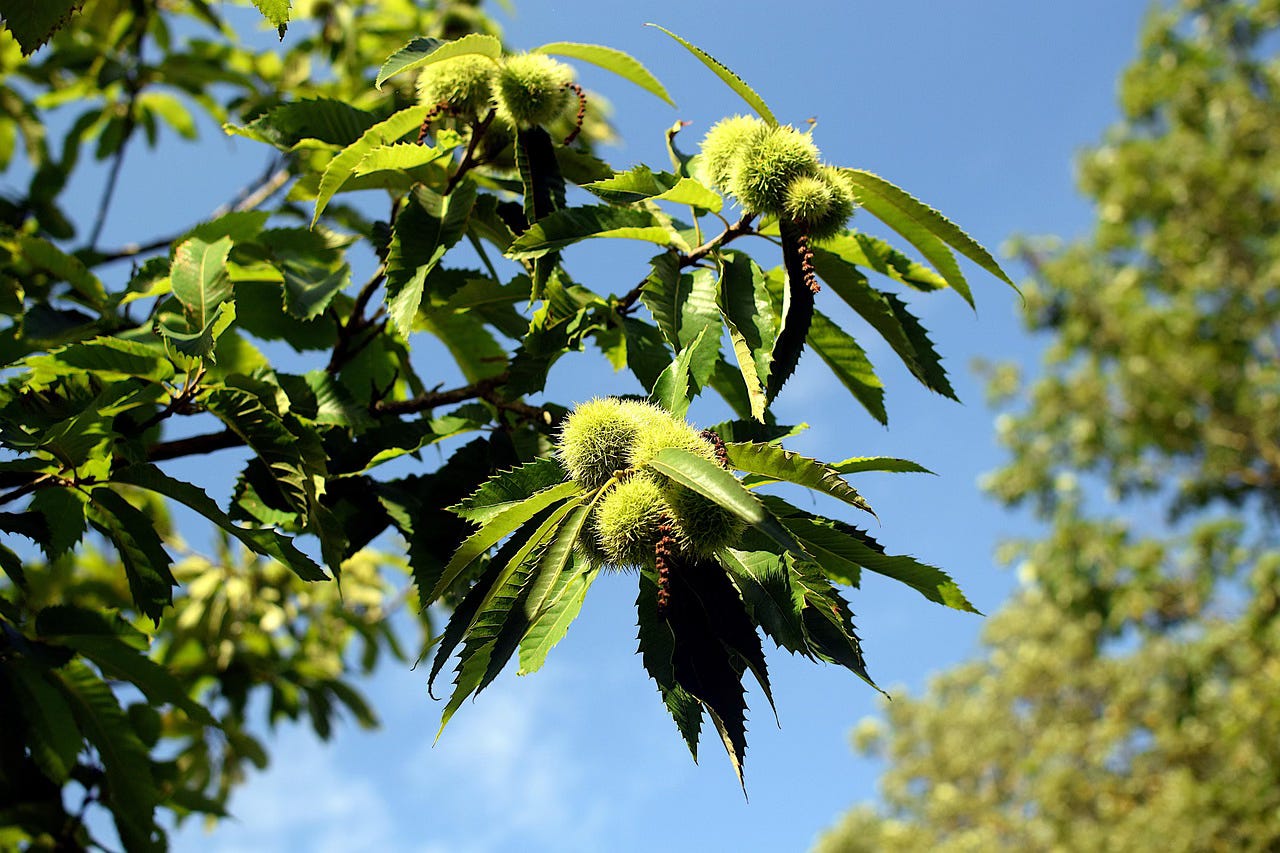
American chestnuts (Castanea dentata) were once one of the dominant trees in many parts of the eastern U.S., with up to 4 billion trees scattered across the Appalachians and surrounding states, according to some estimates.
While there is some discussion about just how dominant the species once was in the forests, sources agree that it was important for both wildlife and people, with bountiful and reliable crops of nourishing nuts for people, squirrels, deer, bears and turkeys. The chestnuts helped fatten hogs and cattle for market.
Chestnuts are also magnificent trees, growing tall and straight; their wood is remarkably resistant to decay, making it ideal for framing, log cabin foundations and fences.
Chestnut blight arrives in North America in the 1800s
All that changed in the late 19th century, when an Asian fungus, chestnut blight (Cryphonectria parasitica), was introduced by accident. While Chinese chestnuts (Castanea mollissima) are resistant to the fungus, the disease spread throughout the American chestnut’s range within decades, killing most of the trees and drastically changing the composition of eastern U.S. forests.
However, some American chestnuts have a natural resistance and survive for a while. To this day, occasional young saplings can be found here and there in the understory of some forests. But the blight kills them eventually, most before they can produce nuts to reproduce.
Past efforts at restoring the American chestnut have centered around interbreeding American chestnuts with the resistant Chinese chestnut to produce a hybrid that is impervious to the fungus, while retaining as many of the native tree’s characteristics as possible.
That has proven difficult – American chestnuts grow tall and fast, characteristics critical to their ecological role in forests. Chinese chestnuts, on the other hand, tend to grow shorter.
“The goal is restoring a tree that can actually compete in the forest and function the way the American chestnut used to,” Holliday said.
Another challenge is the time it takes from seed to knowing if the adult tree will be resistant. It’s a labor-intensive method, in which researchers infect individual trees with the fungus, then wait years to see which survive.
Using genetic data to speed up breeding
The new genomic sequencing method drastically speeds up the process – scientists can now analyze the trees’ genomes to predict which trees will be resistant to the disease.
The team of researchers, led by Jared Westbrook, director of science with the American Chestnut Foundation, analyzed thousands of trees that had already undergone years of breeding and field testing, comparing the genetic patterns with their observed disease resistance.
“With genome-enabled breeding, we expect the next generation of trees to have twice the average blight resistance of our current population, with an average of 75% American chestnut ancestry,” Westbrook said in a statement.
Could purely native trees be bred to be resistant?
The team also studied whether the rare wild American chestnuts that have survived decades of blight on their own might be bred to produce purely native trees that are resistant to the disease, but with no luck.
They found that some did pass on moderate resistance to their offspring, but not consistently enough to be likely to restore the chestnut without support. Still, those trees can be used to supplement restorations.
To identify the genes responsible for resistance, the team analyzed the genomes of both American and Chinese chestnuts, producing reference genomes for both species.
They discovered that resistance to the fungus is complex, controlled by “many genes spread across the genome, working together to strengthen cell walls, trigger chemical defenses and slow the growth of the fungus,” the researchers said in a statement.
This complexity explains why finding a cure has proven so difficult using traditional methods, suggesting that it would take many generations of breeding to produce enough resistant saplings to successfully restore the American chestnut.
What the future holds
While more work remains before large-scale reintroductions can happen, the researchers say the tools are now in place to make meaningful progress within a generation.
“The next generation of trees is expected to start producing large quantities of seed for forest restoration in the next decade,” Westbrook said.
Holliday said, “This is about giving restoration a real chance. We’re not just learning why the chestnut was lost. We’re learning how to bring it back.”
Nature Signals is a reader-supported publication. It takes many hours to write and research each post. To receive new posts in your inbox and support my work, consider becoming a free or paid subscriber.
Not ready to subscribe? Consider buying me a coffee (or a beer…). Any support is greatly appreciated!


Ruth, thank you for this excellent piece. Whenever I read about the American chestnut I come away feeling a little blue. I understand there are pockets of chestnuts that are isolated from the blight but the overall loss is heartbreaking. So glad to read some positive developments in its restoration.
Ruth,
It is quixotic to restore a chestnut to compete in the forest, the way it used to, when organisms that organize and collaborate are more fit for thriving than are those that compete. We are building a Miyawaki forest on a small plot of land in an abandoned ballfield as a pilot demonstration forest. 52 different native woody plants, trees and shrubs, 520 will be planted close together. Each plant species has its own suite of fungi and bacteria that work together in a single mycorrhizal network. When one plant cell puts an enzyme request into the “wood wide web”, it is transported by fungi to a galaxy of bacteria. One bacterium can produce what is requested, perhaps an enzyme to thicken cell walls from a munching pest. Released through the mycorrhizal network, the new enzyme is available to all plants. This is why a Miyawaki forest can grow ten times as fast with many times more soil build-up than a stand of one tree type. We are working in Attleboro, MA, where flood and stormwater management is a very expensive problem, as 10 inches of rain fell in a single day. Six inches of healthy soil can hold ten inches of rainwater. The sponge effect of the forest increases over time.
Trees also release bacteria and fungi into the air. Poplar trees are either male or female. Somehow, trees control which microbiota live on leaf surfaces, the phyllosphere. During drought stress, male and female poplars host different fungal and bacterial genera on their leaf surfaces. Male poplars have microbiota that are more resistant to phytopathogens that inhibit growth. Female poplars have microbiota with higher levels of defensive leaf chemicals that help maintain photosynthate for reproduction.
To restore the American Chestnut, the answer may not lie in the genes but in the full panoply of native woody plants that make up an oak-chestnut forest. It may take a forest to save a chestnut.
https://onlinelibrary.wiley.com/doi/pdf/10.1111/tpj.16283